Kimi’s Challenges: Trust Erosion and the Need for Global Expansion
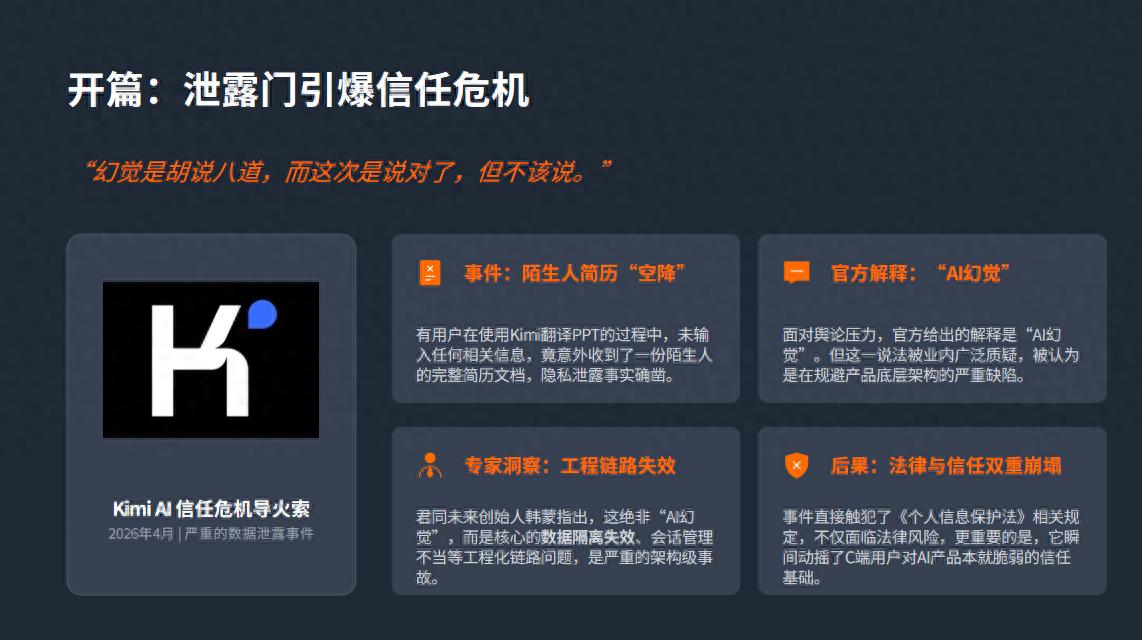
Kimi has recently faced a crisis of trust following a data leak incident that pushed it into the spotlight. A user named Zhang Cheng used Kimi to translate a PPT and unexpectedly received a complete resume from a stranger. The official explanation cited AI hallucination, but Han Meng, founder of Juntong Future, provided a more precise assessment: “Hallucination is nonsense; this time it was correct but should not have been said.” The core issue lies in failures related to data isolation and poor session management.
The data leak has violated the Personal Information Protection Law, directly shaking the already fragile trust foundation among users. Kimi’s problems have been thoroughly exposed.
According to a report by Daily Economic News in collaboration with QuestMobile, Kimi’s monthly active users (MAU) have plummeted from a peak of 36 million to approximately 8.34 million, marking a continuous decline over four quarters. Meanwhile, Doubao’s MAU has approached 350 million, with major players like Alibaba, ByteDance, and Tencent spending billions to capture the market. In contrast, the valuation of the Dark Side of the Moon reached about $18 billion in March 2026. This juxtaposition highlights Kimi’s ongoing losses in the consumer market while capital continues to flow into competitors.
Three Signals of Decline
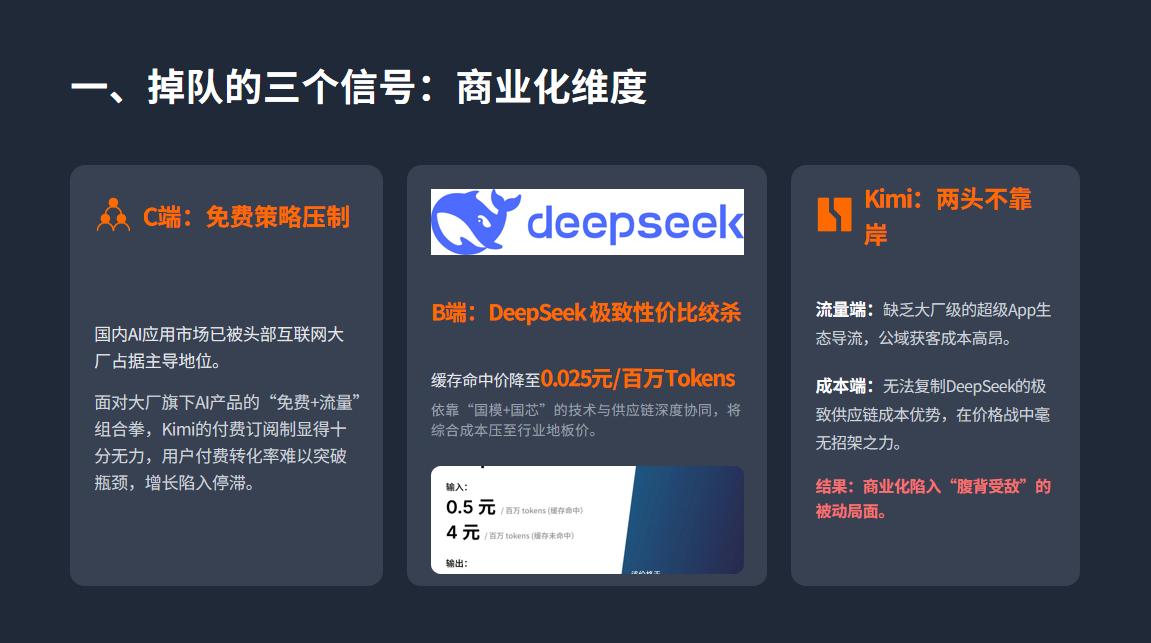
User Dimension: Major companies leverage their ecosystem advantages to crush independent apps. Doubao benefits from its connection to Douyin, while Tongyi Qianwen is embedded in Taobao and DingTalk. Kimi lacks such backing and stands little chance in the traffic battle.
Commercialization Dimension: Kimi is in a passive position in both the domestic consumer and business markets. As reported by Readhub, by the end of March 2026, the overall ARR of the Dark Side of the Moon officially surpassed $100 million (specific revenue composition not disclosed). In early February 2026, Kimi revealed to investors that overseas revenue had exceeded domestic revenue, and after the K2.5 release, the global paid user base grew fourfold.
However, in the domestic API market, Kimi faces direct pressure from the price war initiated by DeepSeek. In April 2026, DeepSeek announced a drop in its caching hit price to 0.025 yuan per million tokens. With a flat team of around 150 people, DeepSeek has managed to push costs to the extreme through collaboration between “national models and national chips.” Kimi, lacking both significant traffic from major companies and DeepSeek’s cost structure, finds its commercialization squeezed from both ends.
The Data Leak Exposes Engineering Shortcomings: DoNews’s technical analysis identified five potential technical paths, with multi-user context contamination deemed the primary cause, pointing to flaws in system architecture and engineering governance. Lawyers have also stated that this has violated the Personal Information Protection Law and the Civil Code.
It is important to note that the drop in C-end MAUs from 36 million to 8.34 million represents a continuous decline over four quarters, with the data leak occurring in April 2026 (Q2). This indicates that significant losses had already occurred prior to this incident. The crushing of independent apps by major ecosystems is the main cause, while the data leak acted as an accelerator.
Narrowing Technological Moat
The K2.5 model itself is not weak. At the end of January 2026, the Dark Side of the Moon released K2.5, which boasts core advantages in native visual capabilities, multi-agent collaboration, and code generation. Within two weeks of its release, K2.5 ranked first on the OpenRouter weekly leaderboard with 1.16 trillion tokens. Commercially, it quickly delivered results—just one month post-launch, the company’s overall ARR surpassed $100 million.
However, the technological moat is narrowing. Homogeneity is a trend in the industry, with differentiation shifting from model capabilities to “product experience + organizational efficiency.” Kimi’s product iteration speed and ecosystem integration capabilities have fallen behind those of larger companies. While technology has not lagged, the technological advantages have not translated into perceptible experiences for C-end users.
Structural Dilemmas in C-end Strategy
Kimi’s choice to focus on the C-end has its strategic logic, but the structural dilemmas of this path are becoming increasingly evident.
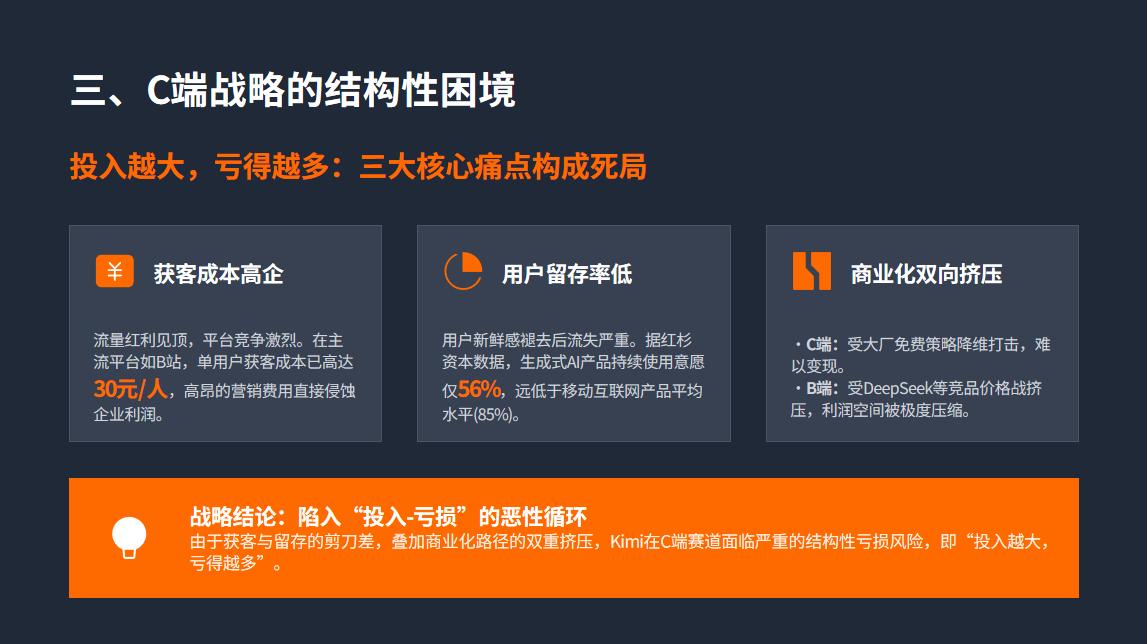
Customer acquisition costs remain high. Data indicates that Kimi’s customer acquisition cost on Bilibili is about 30 yuan per person. Data from Sequoia Capital shows that users’ willingness to continue using generative AI products is only 56%, significantly lower than the 85% for mobile internet products.
The domestic commercialization path is squeezed from both ends. The C-end is suppressed by the free strategies of major companies, while the B-end API is pressured by the DeepSeek price war. The crushing of independent apps by major ecosystems is structural, and DeepSeek’s cost advantage is similarly structural. Organizational capabilities cannot conjure traffic or chips out of thin air for Kimi.
In the C-end arena, Kimi’s situation is that the more it invests, the more it loses.
Going Global: Kimi’s Most Realistic Main Strategy
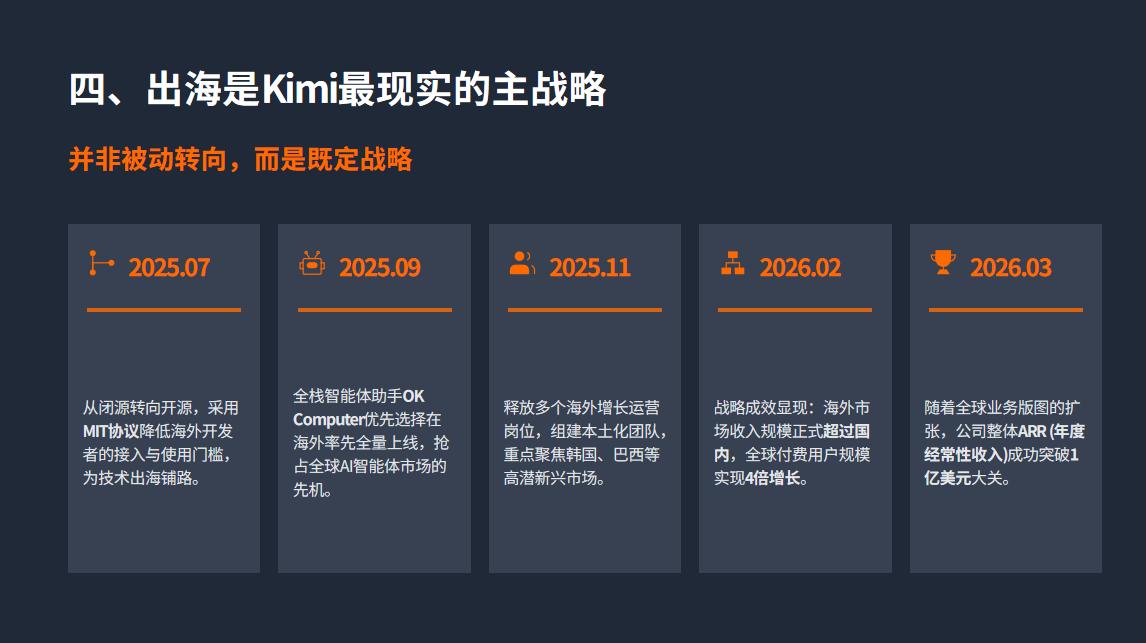
From a timeline perspective, Kimi’s international expansion is not a forced shift after the data leak, but a strategy that has been systematically executed since the second half of 2025.
In July 2025, the Dark Side of the Moon transitioned from closed-source to open-source, adopting the MIT license to significantly lower the barriers for overseas developers. In September, the full-stack intelligent assistant OK Computer was launched overseas ahead of schedule. In November, multiple overseas growth operations and KOL marketing positions were released, clearly focusing on emerging markets like South Korea and Brazil. By early February 2026, Kimi disclosed to investors that overseas revenue had surpassed domestic revenue, and after the K2.5 release, the global paid user base grew fourfold. By the end of March 2026, the company’s overall ARR surpassed $100 million, with clients offering multi-million dollar prepayments to secure computing power. President Zhang Yutong stated at Davos, “Now I encourage everyone to consider overseas markets from day one of entrepreneurship.”
The strategic logic behind choosing markets like South Korea and Brazil is that these markets are not yet saturated by North American giants, have clear localization needs, and Kimi has about an order of magnitude cost advantage compared to OpenAI. For instance, comparing API public pricing: OpenAI’s GPT-4o has a caching input cost of about 15 yuan per million tokens, while Kimi’s K2.5 has a caching input cost of about 1.5 yuan per million tokens, roughly 1/10th of the former. This price difference arises from Kimi’s accumulated advantages in model architecture and engineering optimization.
However, challenges are also clear: South Korea’s ARPU is about 1/3 of North America, while Brazil’s is even lower (about 1/5 of North America), and Kimi’s brand recognition overseas is far lower than that of OpenAI, Anthropic, and Google, even lagging behind Cursor.
Thus, going global is not a question of whether to choose, but rather that Kimi has already spent over half a year advancing this strategy, which has initially validated its commercial viability. The real decision-making issue is whether Kimi dares to shift its main battlefield more thoroughly to overseas markets in the face of continuous losses in the C-end and whether this model can support the $18 billion valuation expectation.
Opportunities and Risks of Going Global
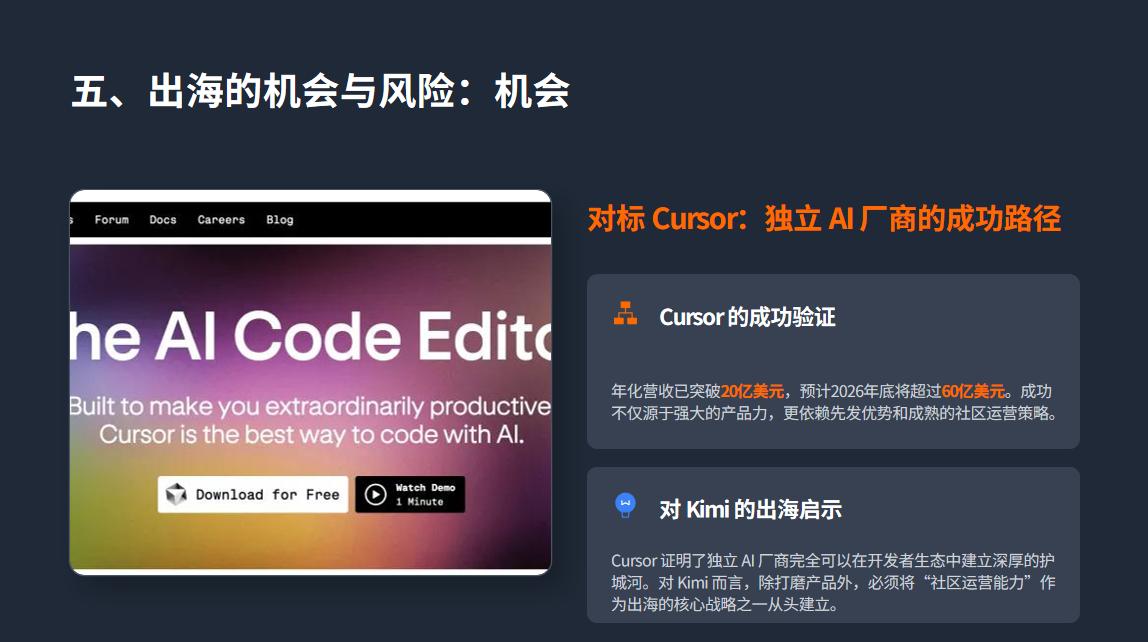
Cursor’s path provides a reference: According to a report by Phoenix Technology in April 2026, Cursor’s annual revenue has exceeded $2 billion and is expected to surpass $6 billion by the end of 2026 (based on its user and revenue growth curve over the past six months). Cursor’s success relies not only on product strength but also on first-mover advantages and community operations—Kimi, as a latecomer, needs to build these capabilities from scratch.
Pricing strategy is also a competitive factor. OpenAI, Anthropic, and Google enjoy brand recognition, ecosystem integration, and capital endurance overseas. Notably, DeepSeek has brought its “national model + national chip” pricing advantage to international markets—by April 2026, DeepSeek’s API pricing in the global market is basically on par with domestic prices, making it one of the fastest-growing Chinese models in the overseas developer community. This means Kimi faces cost competition from DeepSeek overseas as well.
Brand recognition is the biggest invisible barrier Kimi faces in its global expansion. Cursor has almost become synonymous with “AI programming” among overseas developers, and its brand-building path includes continuous technical sharing on Twitter/X, collaboration with well-known developer KOLs, participation in international AI conferences to publish technical achievements, and building community trust through open-source contributions. Kimi can reference this strategy but will require more time and sustained investment. Overcoming the brand recognition bottleneck is a core variable determining Kimi’s success or failure in going global.
Global expansion also carries geopolitical risks. Currently, U.S. AI sanctions against China mainly restrict advanced chip exports and some algorithm export reviews, but they do not directly limit the overseas use of API services. However, this could change at any time and needs to be considered in long-term risk assessments.
Organization: Advantages of a Flat Structure and Transformation Pressure
According to LatePost, the Dark Side of the Moon is described as a rather utopian company—emphasizing flatness, agility, and a lack of hierarchy. The same ultra-flat model has been validated by DeepSeek: DeepSeek maintains a team of around 150 people, adopting a culture that minimizes job levels and is characterized as bottom-up and naturally divided.
Kimi’s organizational problem is not the flat structure itself, but the loss of focus in execution as it expands from a hundred-person scale to hundreds. LatePost reported that Kimi employees lack hierarchical buffers and clear feedback, leading to insecurity. Notably, the core driving factor behind Kimi’s team expansion is the C-end strategy—operations, marketing, customer service, and other functions require a large workforce. If the C-end strategy is one where the more you invest, the more you lose, then the team size itself may be part of the problem.
In December 2025, Zhang Yutong officially became president, which can be understood as a shift from a technology-driven approach to a “dual drive of technology and business”.
The Interconnected Drag of Three Issues
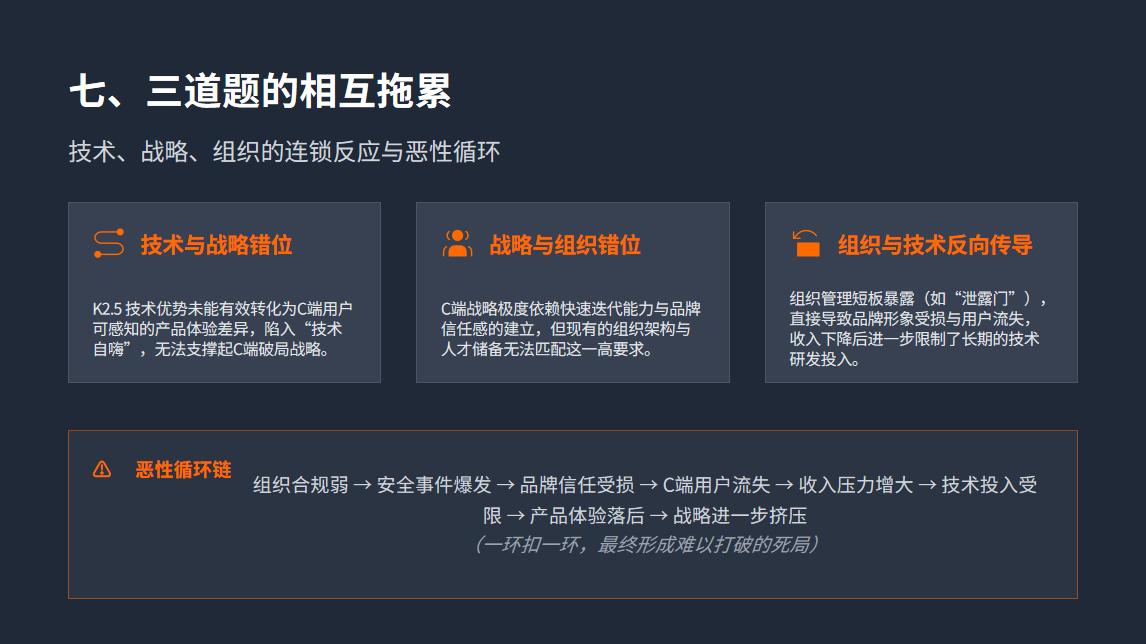
Kimi’s decline is not a single-point failure but a chain reaction of interrelated technical, strategic, and organizational issues.
Technologically, K2.5 has capabilities but has not translated them into perceptible experience differences for users. Strategically, the C-end must contend with the ecosystems of major companies while also supporting the narrative of growth needed for a $10 billion valuation, which is a significant pressure. Organizationally, the ultra-flat structure has led to the marginalization of non-technical functions such as compliance and crisis response after losing focus in execution, with the data leak being a direct consequence.
These three lines drag each other down: weak compliance voice in the organization leads to security incidents; brand trust is damaged, resulting in C-end user loss; revenue pressure increases, limiting technological investment; product experience lags behind larger companies, further squeezing strategy.
Four Actions Kimi Must Take Next
-
Clearly prioritize the overseas developer ecosystem as the current top strategic battlefield. Concentrate main resources on the already validated overseas revenue direction using a rhythm-first and budget-isolated approach. While maintaining a flat culture, this can be achieved by allocating independent budget packages and clear reporting lines—such as establishing a virtual overseas division directly overseen by Zhang Yutong for budget approvals and key decisions, with team members dispersed within the existing organizational structure and synchronizing progress through regular meetings.
-
Improve safety and compliance. Establish a CISO (Chief Information Security Officer) and grant them veto power over compliance before product launches. The CISO should report directly to the CEO to establish a balance between a technology-first culture and safety bottom lines. In a flat organization, the management radius issue of the CISO can be alleviated by establishing a network of safety contacts—designating a safety liaison in each technical group, managed and trained uniformly by the CISO.
-
Complete the redistribution of founding team roles. Yang Zhilin needs to step back from frontline technical details and focus on model route selection and top-level design for the overseas strategy. Zhang Yutong’s responsibilities should be further clarified to specific goals for commercialization and overseas market expansion.
-
Proactively manage capital expectations. Through investor calls, financial report disclosures, and other means, guide the market’s attention to revenue quality indicators such as ARR growth rate and paid user retention rate. If C-end investment is to be actively slowed, a verifiable bottom line should be set—such as achieving $200 million in overseas ARR by Q4 2026 and controlling the C-end user churn rate to within 10%—to convey confidence that slowing down does not equal losing control.
Conclusion: It’s Not About Choosing, It’s About Execution
Kimi’s decline is not simply due to technical inadequacies or organizational shortcomings. The technological advantages have not translated into product perception, the C-end strategy is surrounded by structural forces, and the organization has not held up after scaling.
However, Kimi is no longer in a position to choose a direction. Over the past six months, its overseas layout has shown initial commercial validation. With a valuation of $18 billion, it still has sufficient resources. Cursor has proven that independent AI companies can establish moats in the developer ecosystem, while DeepSeek has demonstrated that ultra-flat organizations can achieve extreme efficiency.
Kimi’s opportunity lies in acknowledging that the C-end battlefield is no longer worth fighting over and elevating its global expansion from a chosen strategy to a necessary main strategy.
In the next 12 months, it will be important to continuously track:
- Overseas ARR: Can it grow from $100 million to over $200 million (by Q4 2026)?
- Second productization direction: Can it develop a verifiable product form in code generation or multi-agent collaboration scenarios, achieving a paid conversion rate of ≥5% (compared to Cursor’s early paid conversion rate of about 7-10%, 5% is a slightly conservative but achievable benchmark)?
- Safety and compliance: Can it complete independent safety audits and establish a CISO, granting safety functions veto power over product launches?
These are verifiable milestones. It’s not about choosing—choices have already been made. Now it’s a matter of execution.
Comments
Discussion is powered by Giscus (GitHub Discussions). Add
repo,repoID,category, andcategoryIDunder[params.comments.giscus]inhugo.tomlusing the values from the Giscus setup tool.